Most “AI app” projects are a chat window over someone else’s API. This is the other thing: a set of macOS applications that each do one job well, share a common substrate, and compose into an assistant that runs on hardware I own.
The parts talk to each other on purpose. Topside publishes file search; Talkie consumes it as a tool. Talkie pushes conversation memory into Windex and queries it back as a retrieval source. The Talkie session protocol serves the Mac UI, an iOS companion, a Safari extension, and — currently in progress — Muzick. The seams are the interesting part.
Roughly 200k lines of Swift across four apps, a 90k-line Python retrieval backend, and about 2,800 tests.
Talkie, Topside, and Muzick are private repositories. LocalMCPKit and Windex are public and linked below.
Talkie — the agent workspace

A native macOS AI workspace in Swift 6 and SwiftUI. Multi-provider chat — native Anthropic, OpenAI-compatible endpoints, Ollama, llama.cpp, LM Studio, OpenRouter — where each conversation pins its own provider, model, instructions, and reasoning mode.
Underneath is a streamed agentic tool loop with bounded multi-round execution, approval-gated command execution, expandable activity, and change review. Nine plugin families extend it: project-scoped code tools, an MCP client, deep research, subagents, web search, memory, Safari tabs, local services, and retrieval sources.
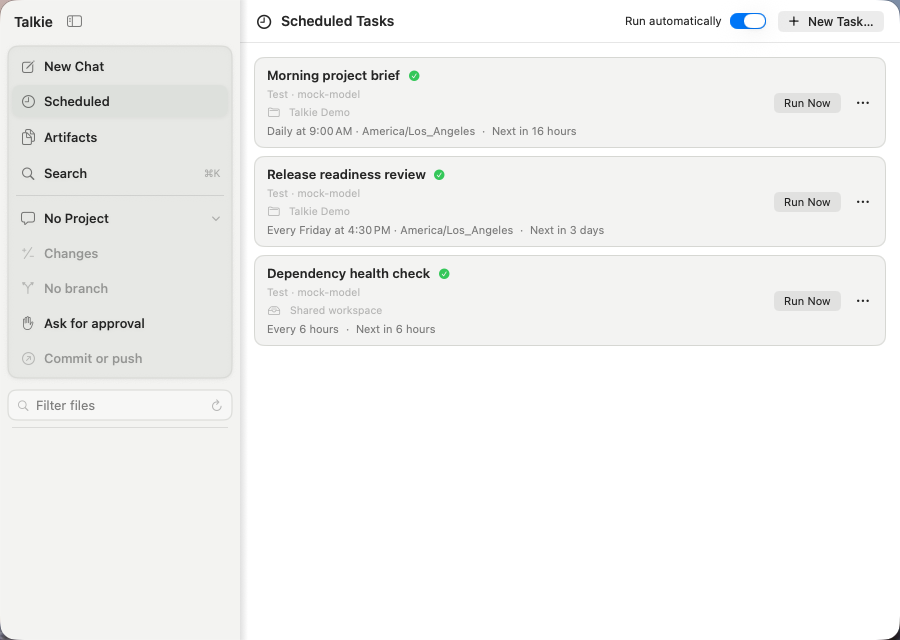
Scheduled agents run one-time, repeating, daily, or weekly prompts. Each keeps an exact model, an IANA time zone, a dedicated conversation, and an optional working project. If that project’s folder goes away — an external drive detaches — the task is visibly blocked rather than silently running somewhere else, and resumes when the folder returns.
Conversations and app state are readable local JSON. Provider credentials live in the macOS Keychain.
The session protocol — one authority, many surfaces
The piece I am proudest of, and the one with no screenshot.
A transport-neutral Swift package makes a single Mac authoritative for every client. It has three ideas worth naming:
Negotiated versions. Client and server exchange version ranges and settle on the highest mutually supported protocol. Old clients keep working; new ones get more.
Revision-stamped projections. Every resource — a conversation, the scheduled-task collection, artifacts, approvals, a change-review scope — carries a monotonic revision. Clients reconcile against a revision rather than re-fetching the world, and a command can declare the revision it expected so a stale write is rejected instead of clobbering.
A durable command journal. A write-ahead reservation reaches disk before the command mutates state. A crash can therefore produce an indeterminate retry — but it can never execute the same command twice. That property is what makes a flaky phone connection safe to retry.
Around those: Bonjour discovery, per-device TLS identity, and capability-scoped grants issued through a commitment exchange that shows a matching verification code on both devices.
Four clients, no server-side special-casing
The protocol earns its keep by how cheap a new surface is.
The iOS companion discovers the Mac over Bonjour on a LAN, or connects directly on a stable port over Tailscale from anywhere. Pairing requires an explicit approval on the Mac with a matching code. Once paired, it drives full conversations, scheduled tasks, artifacts, change review, and approval prompts remotely — the phone is a real client, not a notification mirror.
The Safari extension — a web extension plus a native handler — hands live page content to the desktop agent.
Muzick is the fourth, in progress. Adding it is a client, not a protocol change, which is the entire point of having built the protocol first.
Topside — the file substrate

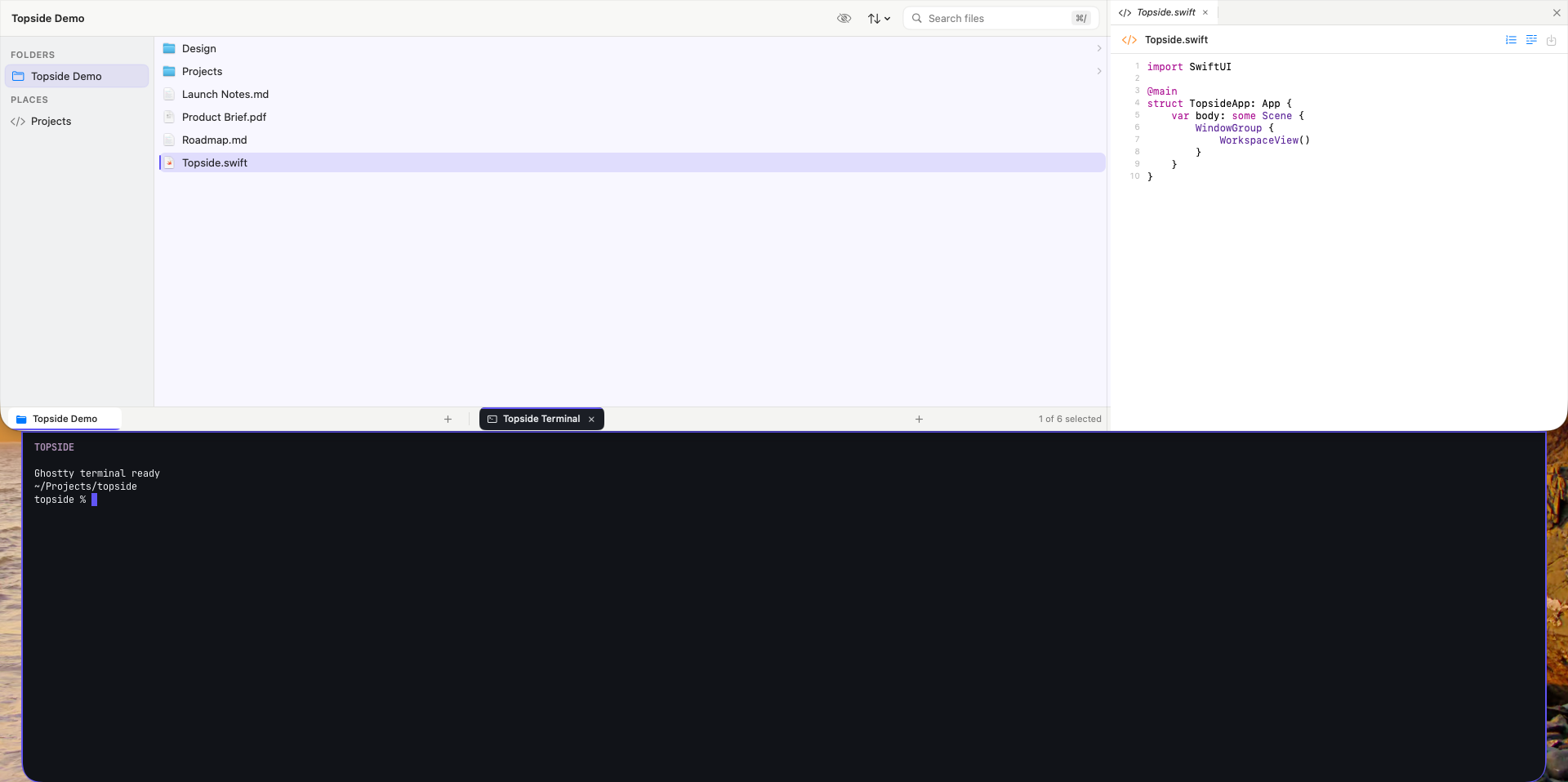
A keyboard-first file workspace that drops from the top of the screen over whatever you were doing. A persistent SQLite index over folders you explicitly choose, with background refresh. Miller columns for deep navigation that keeps the path visible. A tabbed work pane for text, source, Markdown, PDF, and Quick Look. And a real terminal — every tab owns a persistent Ghostty surface and login shell, with bundled terminfo and shell integration.
For the platform, its job is to be a producer: Topside publishes files.folders
and files.search to approved apps over LocalMCPKit. The tool surface is deliberately
narrow — stable metadata only, no file contents, no open/reveal/delete/move, no
arbitrary paths. Pairing never defaults to allow; the requesting identity and a
four-character verification code are shown, and every grant is revocable on its own.
Topside is intentionally not sandboxed, and the reason is written down: a child login shell inherits its parent’s sandbox and cannot use the app’s security-scoped file grants. In exchange, terminal clipboard reads and writes over OSC 52 are denied, protected paste requires confirmation, and closing a terminal with a foreground job asks first.
LocalMCPKit — the secure local transport
github.com/stevemurr/local-mcp-kit · Swift 6 · zero dependencies
One macOS app publishes typed, schema-validated commands as a Model Context Protocol endpoint. Another app on the same Mac discovers it, pairs with explicit user approval, and calls them.
It runs the full MCP 2025-11-25 lifecycle, but carries every message inside an
encrypted loopback envelope: X25519 key agreement, HKDF-SHA256, ChaCha20-Poly1305. The
bearer token, session and protocol headers, and the JSON-RPC body never appear on the
outer wire. The listener binds numeric 127.0.0.1 only, and Bonjour registration,
browsing, and resolution are restricted to LocalOnly. Nothing leaves the machine.
Two design positions I would defend in review:
- Discovery is availability, not trust. A saved grant is never sent automatically to a replacement producer instance. Re-pairing is always explicit.
- Pairing is channel-bound. A commitment → challenge → reveal exchange binds the grant to the exact producer instance and its key, so a look-alike endpoint cannot inherit an approval.
The test suite is adversarial by design — tamper, replay, response-swap, key-substitution, and rotation failures — against deterministic in-memory transports, clocks, and randomness.
Windex — the retrieval backend
github.com/stevemurr/windex · Python · REST + MCP
A search index for agents, on your hardware. Around 16.1M documents from nine public sources — CC-News, GitHub project metadata, Wikipedia, arXiv, Hacker News, the small web, DevDocs, Hugging Face docs — plus one source that is pushed rather than pulled: conversation memory from Talkie. 6.75M documents embedded at 4096 dimensions across per-source Qdrant collections behind aliases, with dense and BM25 legs fused by reciprocal rank fusion.
The parts that took real thought:
Dedup in two tiers. An exact canonical-URL and content-hash ledger, plus MinHash LSH over a rolling window to collapse cross-day wire syndication.
Vectors are derivable. Extracted text and embeddings persist to parquet, so swapping embedding models or recovering from index corruption is a re-embed and an alias flip — never a re-crawl. Model choice is config, not code.
Freshness is one pattern, repeated. Every source uses the same loop: a watermark table finds new upstream work, idempotent batches catch up, a daily job keeps current. Backfill and incremental refresh are the same code path.
Degradation is honest. Under heavy indexing load, hybrid queries fall back to keyword search after a deadline rather than stalling — and the response says so.
The reranker that didn’t ship
I built the eval harness the index is tuned against: a known-item leg, a golden leg of 91 hand-built anchors across seven sources, and an LLM-judge leg, reporting NDCG/MRR/Recall/Precision at k.
Then I trialed a cross-encoder reranker, because RRF scores are rank-reciprocals and aren’t comparable across collections. With rerank on, some documents scored a spurious ~1.0 and outranked the right answer — a CSS fragment beating an on-topic result. I traced it to a caller-side prompt-format bug, fixed it, and measured again.
It still lost. Rerank is off, by decision, backed by data — and the disproven hypotheses are written down so the same ground doesn’t get re-covered. Shipping the negative result is the result.
Muzick — the fourth surface

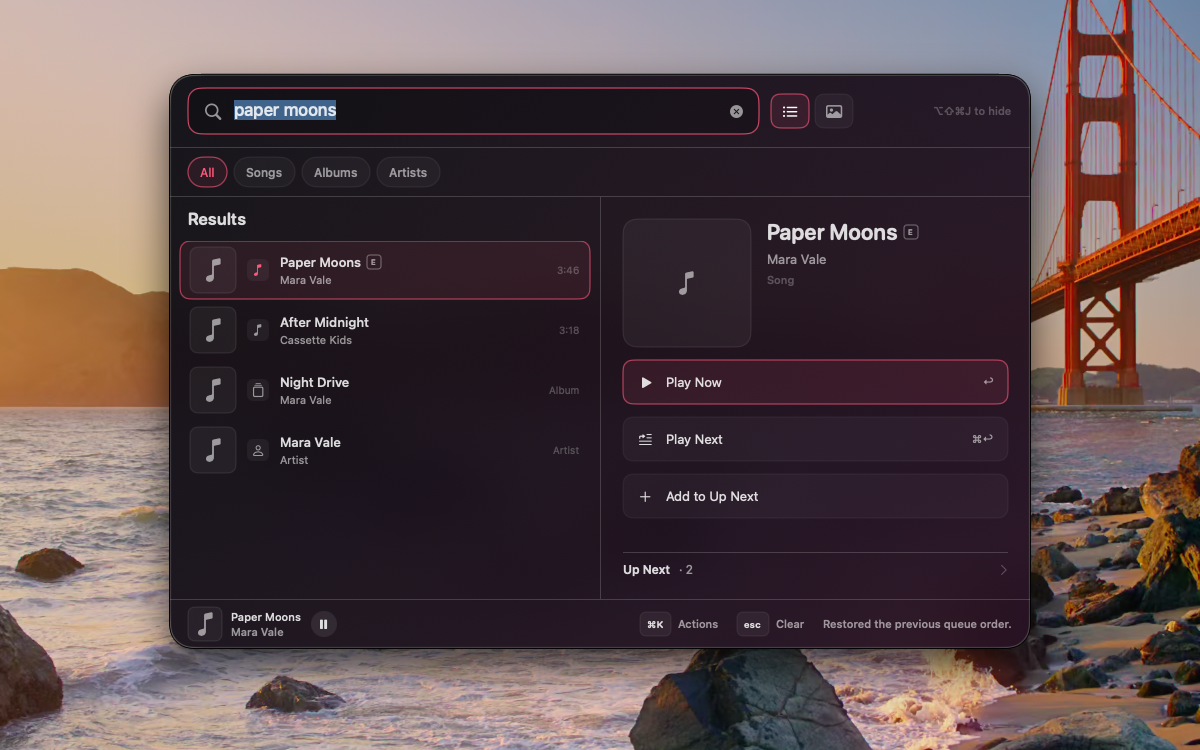
A keyboard-first command palette for Apple Music. SwiftUI hosted in a key-capable
accessory NSPanel, summoned by a configurable global hot-key through Carbon’s
exclusive API. MusicKit’s ApplicationMusicPlayer for an app-owned playback session,
SwiftData for local history and a deliberately separate saved library.
Its scope is defined by what it refuses to do: it doesn’t browse or modify your Apple Music library, doesn’t touch Music.app’s queue, and has no “View in Apple Music” link-outs. It owns its session and stays out of the way.
It is currently gaining a Talkie session surface — the fourth client on the protocol.
How it’s tested
A practice shared across all four macOS apps, worth stating because it is easy to get
wrong: XCUITest bundles never run on the host. macOS UI tests seize the keyboard
and pointer of whatever machine they run on. Every app delegates its UI suite to a
disposable Tart VM through a shared runner that returns an
.xcresult bundle with screenshots and diagnostics.
That constraint pushed a useful design: each app composes deterministic offline services, so the whole thing runs hermetically in a clean VM with no network. Every screenshot on this page was captured there.
Release qualification is scripted too — bundle identity and versions, app icons, privacy manifests, entitlements, signature integrity, Hardened Runtime, and exclusion of test fixtures.