Neural Mixing Console
Can a model learn useful mixing controls from a session’s individual tracks? This research prototype connects instrument-group routing, a differentiable console, and training from both parameters and audio.
Axon
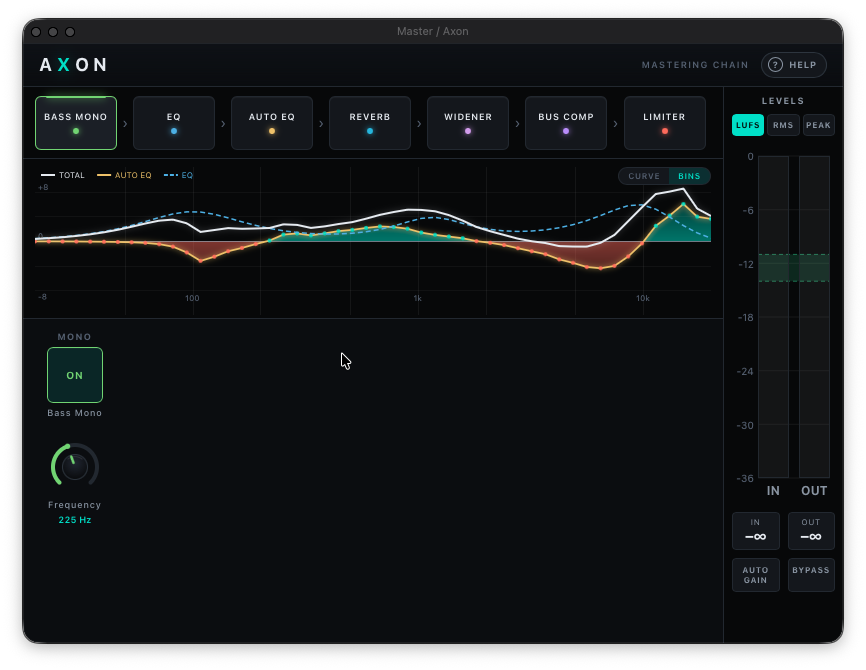
Learning about TCN training and EQ modeling through Neural Mixing Console led me into Axon: an adaptive mastering plugin for Apple silicon, connecting trained audio models to native DSP.
Explore Axon’s source and model bundles
EQDS
To develop Axon’s EQ work, I built EQDS to measure EQ-plugin behavior and produce labeled dry/wet training pairs.
Explore the EQ dataset toolkit
How the projects connect
My experience in music production and audio engineering is the starting point. Neural Mixing Console raised questions about how to train audio models and represent mixing decisions. Learning around TCNs and EQ modeling branched into Axon, while EQDS supported the work on EQ behavior.
The projects remain distinct: a multitrack mixing research system, measurement and training-data tooling, and a native mastering plugin. That connection describes the development process; it does not imply identical DSP or shared model weights.
Neural Mixing Console: implementation and current evidence
The implementation combines Cambridge-MT and Slakh2100 data pipelines, permutation-invariant encoder research, instrument-group DSP routing, and a schema describing the controllable console.
Optimization-derived parameter labels complement audio reconstruction. Multi-song training supports masked supervision for unlabeled sessions and staged reconstruction-loss weighting. Evaluation includes reconstruction, loudness, parameter-distribution, and effective-bypass checks.
The public history records an executed single-song overfit validation. That is a controlled training-path check, not a demonstration of generalization or perceptual mix quality. Broader evidence and listening evaluation remain open; model-driven playback DSP is future work.
Axon: models, plugin runtime, and evaluation
Axon connects LSTM controllers for instrument-class Auto-EQ and a causal TCN modeling an SSL bus compressor at a fixed setting to a native processing chain.
Development spans PyTorch training, ONNX export, and a C++ CLAP runtime with Apple vDSP acceleration. Public source includes model bundles and headless checks for DSP behavior, training-to-runtime compatibility, causality, and performance regressions.
Axon is in development. A published binary release or general variable-setting compressor model is not established here.
EQDS: measuring plugins and producing training data
EQDS deterministically samples EQ-plugin settings, renders calibration sweeps and dry/wet pairs through pedalboard, and labels examples using actual parameter readback.
It preserves absolute levels and extracts transfer functions through sweep deconvolution or Welch cross-spectrum estimation. Resumable process workers and configuration-hashed datasets support repeated data generation.
Its built-in reference is Brainworx bx_console SSL 9000 J, an EQ profile separate from Axon’s SSL bus-compressor model. EQDS provides measurement and training data, without itself establishing a particular trained architecture or fidelity score.